
Baseline Pollinator District — 2022 a year of progress!
By Amy Yarger
Pollinators play a critical role in the food supply for wildlife and people, making pollinators keystone species in most terrestrial ecosystems. Pollinators also serve as charismatic and intriguing ambassadors for the natural world. Not every person will see a whale or a polar bear in their lifetime, but bees, butterflies and other insects impact all our lives, and our actions have a direct impact on them, too. Pollinator conservation is a field in which everyone can participate and make a positive difference, whether by planting a garden or being a community scientist. And the habitats that we protect for pollinators are healthier for humans, too.
Colorado is a great place for pollinators, with 946 species of bee and 233 species of butterfly. There are many reasons for this pollinator biodiversity, from a robust network of natural areas to the presence of major rivers which can serve as biodiversity corridors. Colorado also features many biomes, due to the variation in altitude, climate and vegetation found throughout the state. But the state has also seen tremendous growth which can result in the disturbance and destruction of habitat for pollinators and other wildlife.
One of Butterfly Pavilion’s key programs for improving the future for pollinators and for people is the Pollinator District program. A Pollinator District is a community, including businesses, schools, public facilities and parks, designed, constructed and maintained in such a way that pollinator habitat demonstrates a net gain over the footprint of development. This September, Butterfly Pavilion certified the inhabited portion of Baseline as the first Pollinator District in the world.
In order to be certified as a Pollinator District, a community must demonstrate an increase in pollinator habitat and in pollinator diversity and abundance. Prior to construction at Baseline, Butterfly Pavilion scientists performed a pollinator survey at the Baseline site. This 2019 study included a visual activity survey, a habitat assessment, and collection of insect specimens via sweep net, aerial net and traps. In 2022, Butterfly Pavilion returned to the landscaped portions of Baseline to perform follow-up early season and late season visual activity surveys across all landscaped areas.
During the 2019 survey, the Baseline location consisted of sparse and degraded vegetation, dominated by exotic plant species. Pollinator habitat was almost nonexistent, except for in the drainages and roadsides which supported scattered individuals of annual sunflowers (Helianthus annuus) and showy milkweed (Asclepias speciosa). At that time, we found 11 different families of pollinating insects, including sweat bees, mining bees, bee flies and spider wasps. These pollinator families are often found in disturbed plant communities, due to their ability to forage on many different species of plants. Several common pollinator insect groups were noticeably absent from this initial sample, notably social bees and butterflies.
Since that initial survey, the landscape at Baseline has changed dramatically. Butterfly Pavilion works with McWhinney and the City and County of Broomfield to ensure that new landscaping includes plants that will offer food and shelter for pollinators, while also saving water and thriving in Colorado’s challenging conditions. The latest results, based on this year’s survey, are very encouraging.
In 2022, we observed pollinators from 18 families, compared to only 11 families in 2019. The most abundant pollinators we observed were honeybees (289 observations), and Colorado soldier beetles (131 observations). Honeybees were also the most widely distributed pollinator across all sample points in the developed portions of Baseline. Honeybees are introduced to North America as a pollinator and provider of honey and wax. These honeybees at Baseline may be from managed hives in the area or even from feral hives. The bee family that honeybees belong to (Apidae) was not present at Baseline at all in 2019 but is now represented by 8 different species at the developed portions of the Baseline development. Four of those species were bumblebees, including the southern plains bumblebee (Bombus fraternus), brown-belted bumblebee (B. griseocolis), American bumblebee (B. pensylvanicus) and the black and gold bumblebee (B. nevadensis). Different bee species require different resources for nesting – ranging from ground nesting to nesting in soft wood to building nests in sheltered areas, so finding so many native bee species is a good sign that habitat is available at Baseline.
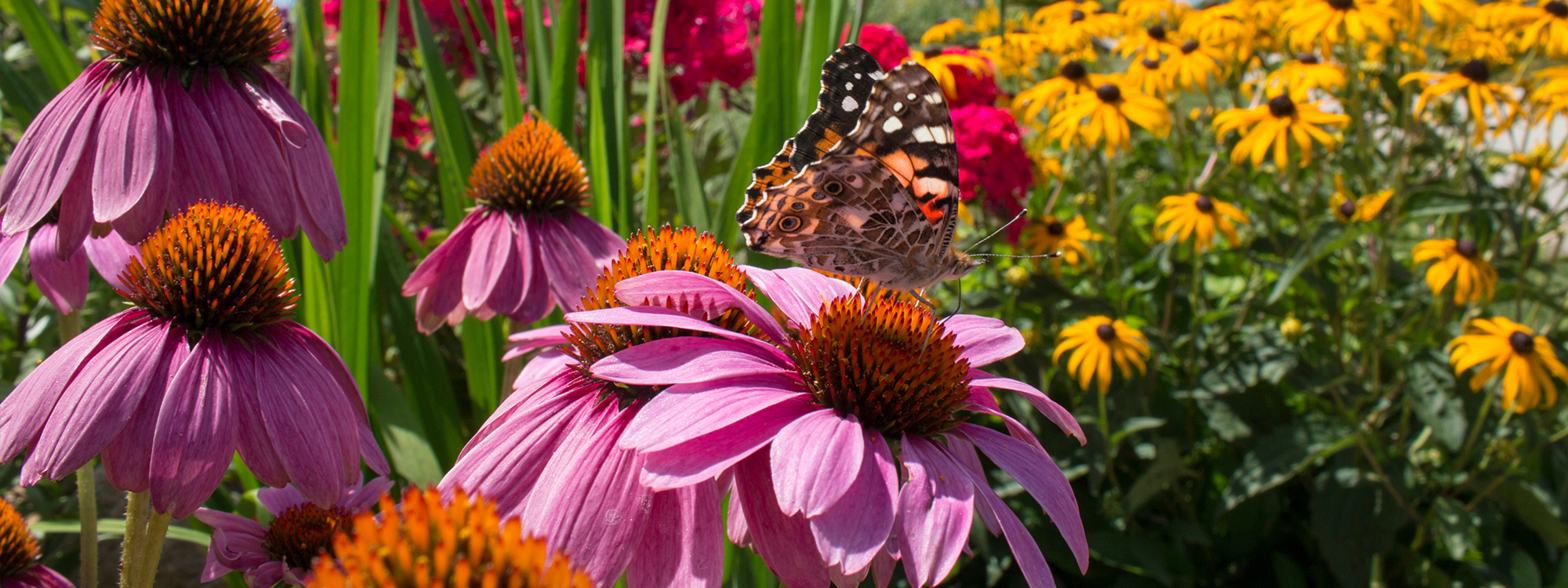
Butterflies also have specific reproductive needs, so their presence indicates that host plants and shelter are available locally. The butterfly species observed at Baseline in 2022 have a wide geographic distribution and broad host plant associations. Butterflies such as gray hairstreaks (Strymon melinus) and painted ladies (Vanessa cardui) are often found in urbanized and disturbed environment because they lay their eggs on many kinds of plants and can tolerate a wide range of conditions. Butterflies were seen in small numbers at Baseline, which indicates that the habitat doesn’t yet support large numbers, but we hope to see increases in populations as more habitat is improved.
Future phases at Baseline will include more habitat for pollinators throughout residential areas, parks and even the urban core. It will be key to monitor pollinator populations over time to ensure that the Pollinator District fulfills its aim. During the summer of 2022. residents of Baseline were encouraged to participate in a summer-long pollinator count to capture observations of pollinators in backyards and parks. During that time, volunteers recorded 147 total observations of 87 insect species. 2023 will offer increased opportunities for Baseline residents to get involved in the pollinator count and other projects.
Baseline is a growing and vibrant community, attracting involved and enthusiastic people who want their community to reflect their values. Certification as a Pollinator District communicates the commitment to uphold science-based standards and practices for pollinator habitat throughout the development. These interim survey results show that “if you plant it, they will come” and that Baseline has a lot to be proud of!