
Written by Amy Yarger, Butterfly Pavilion Horticulture Director
Spring has its own energy. We emerge from our winter hibernation ready to take on challenges, fill up our calendars, and try new experiences. However, I hope that none of us is too busy to savor the signs of spring in our gardens and landscapes. The crabapples loaded with graceful blooms, the daffodils like spots of sunshine – these are hard to miss and bring a feeling of delight to most of us. But bugs zooming out of holes in the ground? Maybe not so much delight…unless you know what you are looking at.
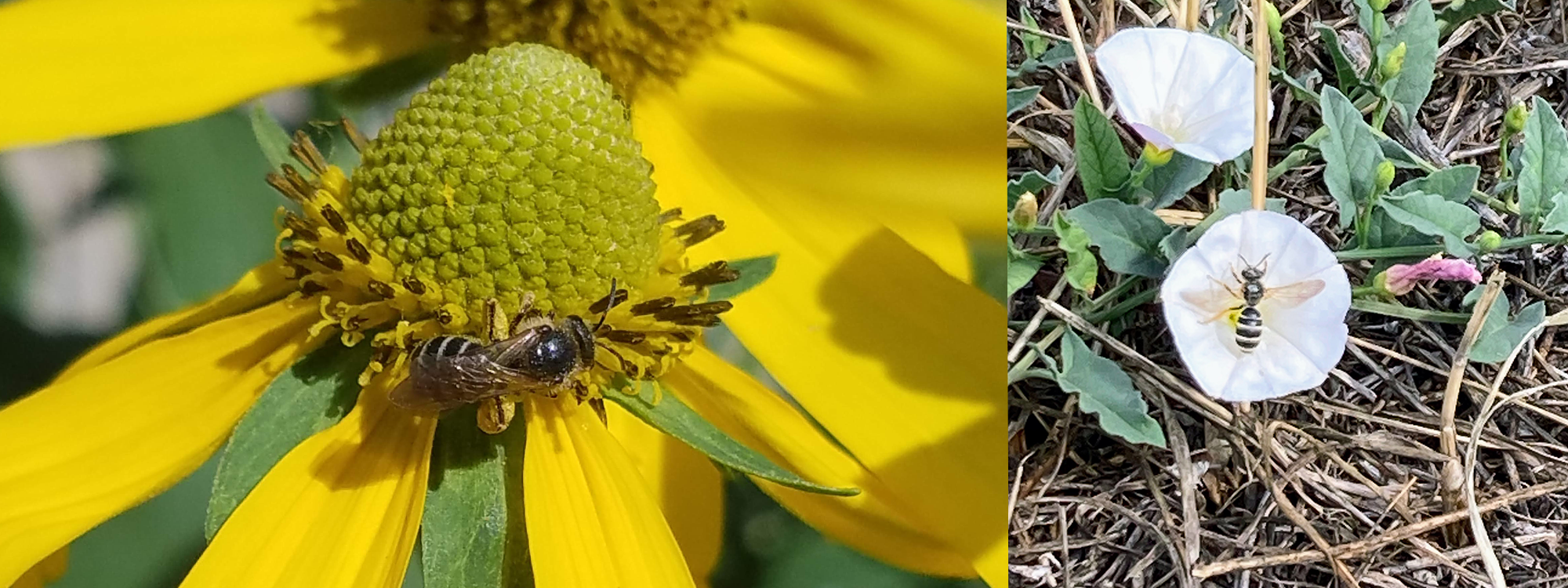
I would like to argue that mining bees are a signal that spring is with us, and for such a small insect, they bring us enormous benefits. Mining bees, in the family Andrenidae, are small (.3 to .7 inches long) fuzzy bees, often with bands of pale hairs on their abdomens. The ones we are likely to see in our area tend to be subdued in color; their bodies may be tan or grayish with the brightest color coming from the pollen they carry high up on their hindlegs in specialized hairs called scopa. There are many kinds of mining bees in North America, 450 species, and most are difficult to tell apart without serious magnification.
But you might go years without seeing the actual bees, which are quick and ephemeral. What most people observe are the nests that mining bees make every spring. Mining bee nests might be confused with anthills or wormholes, but they are characterized by a larger hole, about a quarter-inch in diameter, surrounded by a slight mound of loose soil. These holes are visible for a brief period in the spring in bare spots, especially where the soil drains better and where there’s a little shade and protection from plants or other structures.
About seventy percent of our native bees, including mining bees, nest in the ground. Mining bees are solitary nesters, with each female creating her own burrow about 4 inches deep in the soil. Female mining bees do their own digging, creating side tunnels and even waterproofing their chambers via a gland on their abdomen. Although mining bee nests may be found in groups, each female takes care of her own brood. Bare ground is key habitat, but it doesn’t have to be a huge patch of bare ground. The perfect place for their babies to grow up is a site that is somewhat protected, not likely to flood or be too soggy, and close to food sources.
Once the female bee has built her nursery, she visits early-season blooming plants such as fragrant sumac (Rhus trilobata), creeping Oregon grape (Mahonia repens), and dandelions (Taraxacum officinale) to gather pollen and nectar. She rolls the pollen into tiny balls to provision her nest. Only when the chamber is ready and stocked up will the female venture out look for a male bee. After mating, the mother lays one egg on each pollen ball, then seals up the chamber. As the spring turns to summer then to fall, the tiny grublike larvae subsist on the food their mother has left for them. In the fall, the larva pupate, but the new adults will stay underground waiting for the following spring to come out and continue the cycle.
They are only active for a few short weeks, and don’t have any lasting negative impacts on turf or other plantings. They don’t cause bare patches in turf – they make use of those patches because they are available. Meanwhile they are key early season pollinators for food crops such as berries and stone fruits as well as native plants. Even though people often feel a little intimidated by insects coming out of the ground, these docile bees don’t pose a substantial sting risk. The males often don’t even have stingers, and the females are more likely to fly away than try to defend themselves with a sting. They don’t have huge nests with lots of babies or lots of resources, so they are less defensive than creatures like honeybees and yellow jackets.
The best way to ensure that mining bees can survive in our landscapes is to leave their nests undisturbed whenever possible. Remember that these nests will only be visible for a month or so! Areas with landscape fabric are poor habitat for these tiny beneficial insects, so pollinator gardens should be landscape fabric free. You can also plant early-blooming spring flowers as a food source. Native bunch grasses and shrubs provide shelter in the garden for when our spring weather zigzags from arctic to balmy.
Want to learn more about pollinators and how to help them? Contact Butterfly Pavilion’s horticulture department at habitat@butterflies.org!
If you see this pollinator or others around Baseline, take a picture and upload it to Baseline’s iNaturalist page. By doing so, you can be a citizen scientist and help track the diversity and volume of pollinators at Baseline.