
What 2024 taught us about our pollinators
By Amy Yarger, Butterfly Pavilion Senior Director of Horticulture
Each year, Butterfly Pavilion science staff conducts pollinator surveys at Baseline so that we can evaluate how the pollinators are doing in the Baseline Pollinator District. The team found that not only are many kinds of pollinators finding resources across Baseline’s landscapes, but there have been some interesting changes since last year. During our spring and summer surveys in 2024, we observed 1112 pollinating insects from 18 different families foraging on flowers at Baseline. This diversity is consistent with our findings over the past two years, but the number of individuals has increased significantly this year.
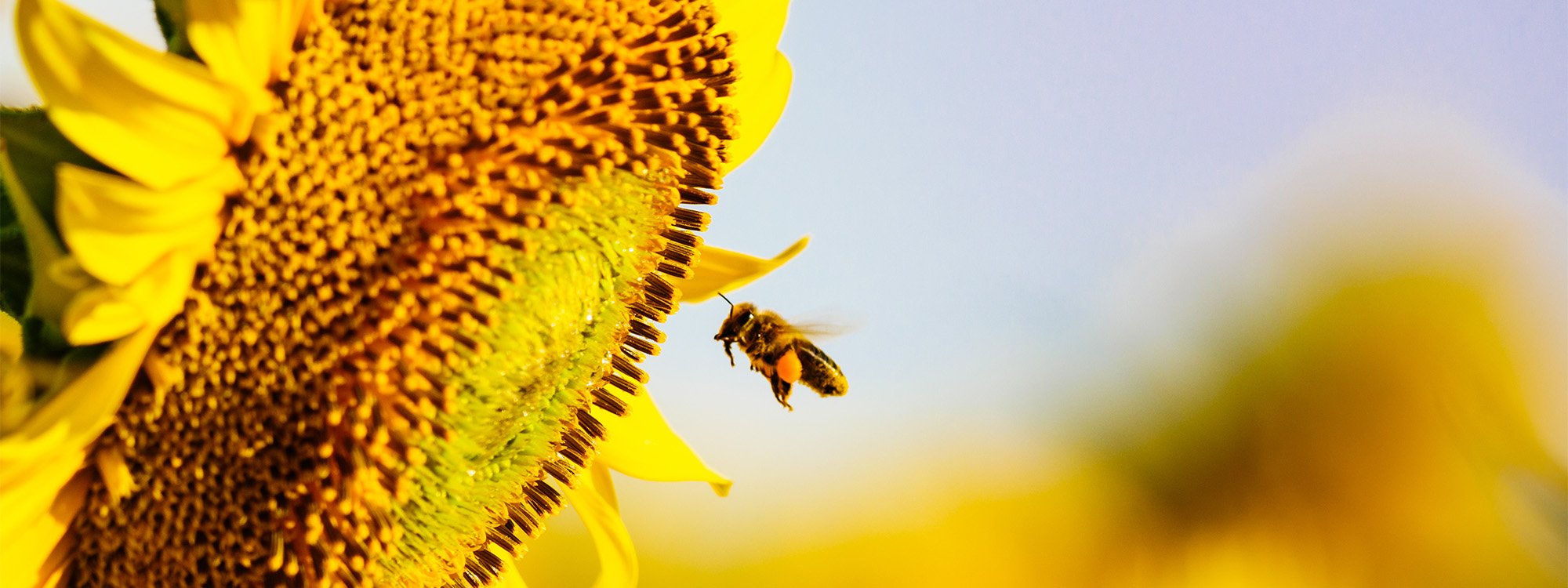
The reason? Western honey bees (Apis mellifera) were the most abundant pollinators we observed at Baseline this year, and their numbers were much higher this year (815 sightings) compared to 2023 (395 sightings). The western honey bee, which was originally introduced from Europe, is an excellent example of a generalist pollinator; Baseline’s honey bees visited 24 different species of flowering plants at Baseline this year, far more than any other pollinator species did. The plants with the most visits in the late summer survey were dominated by western honey bees – Russian sage (Perovskia atriplicifolia) and blue spiraea (Caryopteris x clandonensis). These plants were extremely common at Baseline which also makes them easier for honey bees to find. The honey bee’s ability to forage from a broad palette of flowers makes them very adaptable, which can increase competition against native pollinator species. We don’t know why so many honey bees have suddenly arrived at Baseline, but we will keep track of this trend over the next few years.
Sweat bees (family Halictidae) are the most common native pollinators at Baseline. These small bees can be easy to overlook, but they visit a wide variety of flowers, including yarrow, coreopsis, blue flax, shrubby cinquefoil, sunflowers, and rabbitbrush. Many of these bees are also ground nesters, so avoiding the use of landscape fabric wherever possible is key to creating habitat for them. The most widely distributed native pollinator was the furrow sweat bee (Halictus sp.), which we observed in 6 out of 9 sample points at Baseline. Other notable native pollinators at Baseline include soldier beetles, bumble flies, parasite flies, and two-tailed swallowtail butterflies. These helpful native pollinators are present in low numbers at Baseline but eagerly visit flowering plants in parks, streetscapes, and residential gardens.
In an urban landscape, such as Baseline, having enough high habitat value plants is key to increasing pollinator populations. High habitat value plants are usually native to the region and have close associations with a variety of pollinators. Often, these plants provide forage during times when forage is limited, such as early spring and late summer. Annual sunflowers (Helianthus annuus) are a superlative pollinator resource, providing mid and late summer forage to bees, butterflies, wasps, flies, and beetles. Some bee species specialize on sunflowers and nothing else: longhorn bees (Svastra sp.) and sunflower longhorn bees (Melissodes sp.). These specialists are present in small numbers (fewer than 10 observations) and are only found where sunflowers are growing. In Baseline, there are frequent pockets of annual sunflower (Helianthus annuus) and occasional perennial Maximilian sunflowers (Helianthus maximilianii). If you want a simple way to help many different pollinators, adding a few sunflowers to your container gardens or backyards is a great way to start!
Winter is almost upon us, and our pollinators are in their quiet phase. But spring will be here before we know it, and then you are bound to see some of these fascinating insects in your very own neighborhood! There are many fun ways to get involved to make Baseline an even better place to live for pollinators and for people. If you’re interested in learning more, here are some great ways to get started.
- Get involved with Baseline’s community science, upload pictures of pollinators you’ve observed at your home or around the neighborhood to Baseline’s iNaturalist page
- See other community science projects.
- Butterfly Pavilion garden & landscape tips